
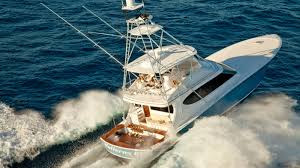
Back in 1959, when most of the marine industry was still using traditional materials like wood to construct boats, angler Willis Slane, the founder of Hatteras Yachts, sought to build a different type of yacht. Keen to build a yacht that was able to withstand the stormy seas off the coast of Cape Hatteras, in North Carolina, it was after Slane visited the Cristaliner Corporation in Miami and tested a 27-foot fiberglass race boat, that he became convinced he could build a larger sportfisher from the same material. Partnering with
fibreglass boat-construction pioneer at the time, Don Mucklow, and naval architect Jack Hargrave, they designed and built a new type of sportfishing yacht with a fast-planing hull, the Knit Wis.
The result wasn’t just the birth of a new company, Hatteras Yachts; it was also the start of a shift across the yachting industry. The iconic Knit Wits, a 41-foot convertible yacht fisherman made from fibreglass, which could reach speeds of over 30 knots, was launched in 1960 and revolutionized how yachts were produced. The first fibreglass yacht ever built that measured more than 40 feet, she features a sharp entry, flared bow, and exceptional American craftsmanship, and reshaped the sportsfishing yacht category for good. Now, more than six decades later, Hatteras Yachts continues to define what owners expect from a serious sportfishing yacht, as it spearheaded the progressive convex and modified-V hull.
The yachting industry’s initial skepticism toward fiberglass construction was understandable; after all, wood had dominated yacht building for centuries. However, following her launch, Knit Wits helped pave the way for other manufacturers and builders to shift from wooden to fibreglass construction. For many shipyards, the advantages became immediately apparent: superior strength-to-weight ratios, resistance to rot and marine borers, and consistent manufacturing quality that wooden construction couldn’t match. As such, Hatteras Yachts went on to become a very dominant player in the 1960s and 1970s by taking that leap in fiberglass production. The success of Knit Wits saw Hatteras Yachts develop a series of production Convertibles, sportfishing yachts that were equally capable of competing in fishing tournaments and providing comfortable cruising, a key versatility aspect that appeals to many owners. By the late 1960s, Hatteras offered a full line of models, including the Hatteras 50 MY, the largest production fiberglass motor yacht then available, demonstrating the shipyard’s early recognition that size and capability could coexist with manufacturing efficiency.
Today, Hatteras Yachts continues to innovate when it comes to hull construction. Recognising that Knit Wits was slightly “overbuilt” due to the fact that Slane and his team did not know many layers of fibreglass were needed to ensure the hull was fully seaworthy, the yard has invested in refining its production capabilities. The shipyard’s current manufacturing processes use a combination of quality fibreglass and vinylester resin for the best strength, toughness, and durability. Hatteras Yachts employs its own proprietary vinylester resin infusion technology, a method that relies on vacuum pressure to precisely draw the resin through the fiberglass structure, providing optimal firmness and sturdiness. Each hull mold receives a full coat of high-performance vinylester gelcoat below the waterline to enhance resistance to bottom blisters—a step most competitors skip. An additional epoxy resin layer is then applied to the hull bottom as part of the anti-fouling system for extra protection.
The hull design itself reflects decades of refinement. Computer-aided design optimisation has further enhanced the traditional Carolina-style hulls that made Hatteras famous, improving hydrodynamic efficiency while maintaining the seaworthiness that defines the brand. Variable deadrise angles are precisely calculated to deliver both a smooth ride in rough conditions and efficient performance across different operating ranges.
Offering superior hull construction that offers a smooth, stable cruise no matter how rough the waters may be has helped Hatteras Yachts secure its position among the leading builders of convertible sport fishing yachts. Curious to learn more about the shipyard and its models? Contact TWW Yachts to learn more about how Hatteras Yachts’ engineering innovation translates to your specific yachting requirements, whether for Mediterranean cruising or serious offshore fishing pursuits.